
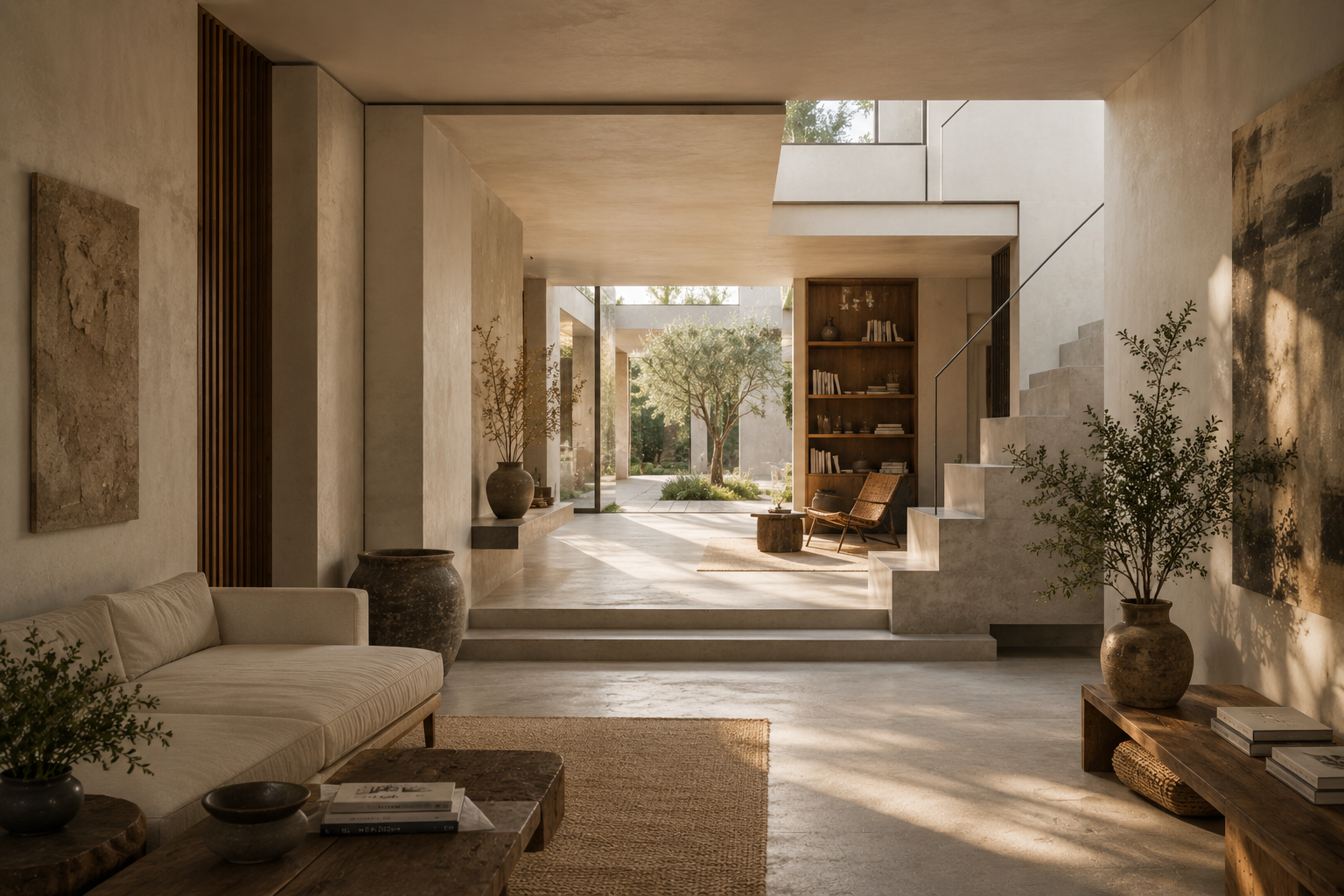
In the IRRINIUM vision, architecture is not only an art of building: it is an art of revealing the resources of a place. Behind every project lies a space that carries a history — sometimes discreet, sometimes determining — and that calls to be read before being modified. For a space is never neutral: it preserves the traces of the uses, configurations and events that have traversed it, but also the potential of what can still come to be.
Creating with discernment is first to read this multiple reality before even conceiving a form. It is approaching the space as a singular system, with its inherited constraints, its points of tension, its unexploited potentials. It is composing with nature, light, circulations, the history of materials and the configuration of the terrain, in order to allow the adapted form to emerge — the one that responds to both functional requirements and the quality of habitability the place can offer.
The history of places: a reality that every design must integrate
Every place carries a history. Even an apparently virgin terrain possesses an imprint made of geophysical characteristics, previous uses, past events. When this history is ignored, the constructions implanted there can generate dissonances: diffuse discomfort, instability of use, absence of perceived habitability quality.
IRRINIUM is committed to integrating this dimension before any creation. Through an approach of fine observation and analysis, we read the configuration of the site in order to understand what structures its dynamic and what can impede or support the project. This work, often discreet but fundamental, opens the way to a more just design, better anchored in the reality of the place.
When form emerges from listening to the place
Every IRRINIUM project is conceived as a conversation between real constraints and the vision the place permits to attain. Forms are not imposed: they are revealed through observation. Through an attentive reading of space — its proportions, orientations, flows of light and circulation — we allow the most adapted lines, volumes and configurations to emerge.
Thus, architecture becomes a response to the place. It composes with the natural movement of wind, the trajectory of the sun, the breathing of the landscape. What is then constructed is no longer merely functional, but profoundly coherent with its environment: a place that welcomes, supports and enables what it was designed for.
The habitat as a lever of quality of life
Living in a truly balanced space transforms the relationship with oneself and with daily activity. Architecture then becomes a lever of quality of life: it supports clarity, stability and the capacity to work or to restore oneself effectively. Surfaces and volumes cease to be simple delimitations: they shape the experience of those who move within them.
In this vision, the practitioner is no longer only a builder: they become a guarantor of coherence. They connect technical requirements to actual uses, material constraints to human intentions. Each project becomes a work of integration, a space where form and function converge.
Toward an architecture attentive to the place and its inhabitants
The current epoch invites us to rethink our foundations — in the literal sense as well as the methodological. We can no longer conceive a space without taking into account its environmental context, its history and the quality of habitability it can generate. Every construction, every arrangement, every choice of implantation must inscribe itself in an attentive approach, respectful of the terrain’s balances and the real needs of occupants.
IRRINIUM works in this direction: creating places that function in harmony with their environment, where perceptual quality is not a decorative luxury but an essential component of the project, for it emerges from a balance between technical rigour and attention to uses.
Conclusion
A space lived with quality is not a utopia. It is a tangible reality for those who know how to read a place before modifying it. By restoring its place to the perceptual dimension in the act of building, we relearn to inhabit the world differently — no longer by imposing a form, but by revealing what a place can become.
At IRRINIUM, we do not only build spaces: we diagnose their dynamic and accompany their transformation.
Yannick Costechareyre